
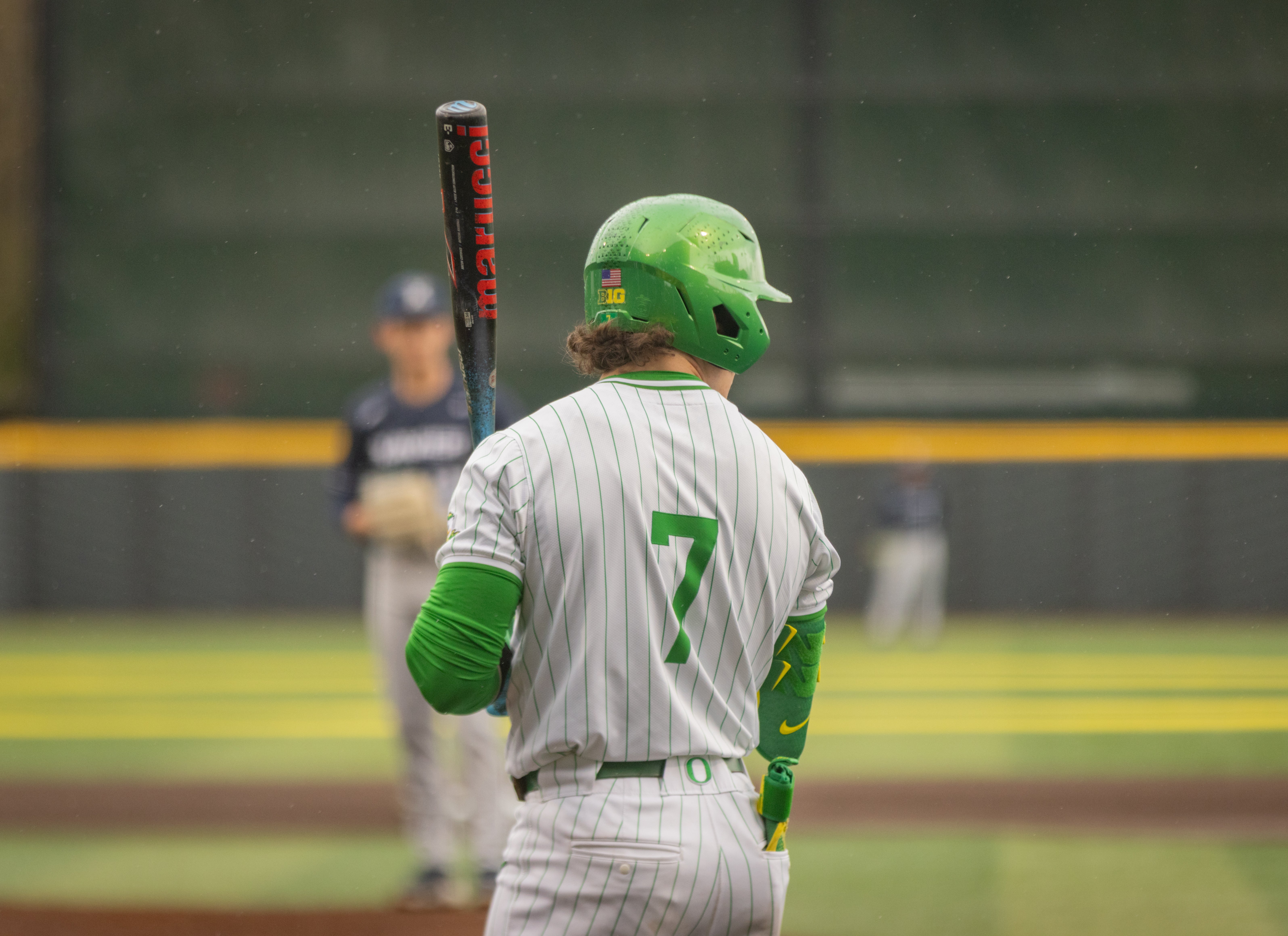
College baseball season always has turning points. For the Oregon Ducks, that moment often arises before conference play begins. Non-conference games build momentum and confidence, allowing teams to see what is working, but conference matchups are where games truly matter. If Oregon wants to have a chance for the top in the conference standings, it has to be able to have consistency throughout the whole season.
In their first season in the Big Ten last year, the Ducks made an immediate statement, finishing as conference champions. Oregon went 20-8 in non-conference play and 22-8 in the Big Ten. Early in Oregon’s season, it typically shows parts of what it’s capable of.
Some games show their explosive offense, with runs coming from throughout the lineup, such as their 18-1 victory over the Youngstown State Penguins early in non-conference play. Other games showcase their defensive play — like when freshman Angel Laya robbed a hitter of a home run — or dominant pitching performances where arms like Will Sanford recorded six strikeouts and no runs in six innings.
Performances like this prove that the Ducks have a talented team, but talent alone is not enough to survive the grind of conference play.
Conference teams are familiar with their opponents, they are aware of player statistics, scouting, and pitchers understand hitters’ tendencies, as every matchup carries more weight in the standings. Because of this, inconsistencies and off days become far more noticeable and more costly. A strong weekend could be overshadowed by a disappointing performance in the following week, and could lower standings, which teams cannot afford to happen in long stretches of play.
Oregon has all the pieces to succeed. So far this season, the starting lineup has shown it can produce runs and set the tone early in games. When the offense is clicking, it puts pressure on the opposing defenses and forces pitchers to work into deep counts. The challenge is maintaining consistency when playing back-to-back games.
Long stretches without hits or struggles with runners in scoring position can quickly change the outcome of the game. That issue surfaced early in conference play when the Ducks opened their series against Purdue. Oregon won the series 2-1, but the inconsistency was evident. The Ducks lost the second game 2-1 with only eight hits, only to bounce back and win the next game 15-4 with twenty hits. The Ducks then beat Xavier in a mid-week game 10-0, ending in the eighth inning on a mercy rule with eleven hits — including a grand slam from Jax Gimenez. Those drastic hits are difficult to sustain later in the season.
“I think we beat ourselves last week. My goal was to come out and play our game today, and I think we did that really well,” Gimenez said. “I like how we can bounce back from this weekend.”
Consistency is important in all aspects of the game, including the mound. Strong starts from pitchers allow for the bullpen to stay ready and give the offense room to work without the pressure to immediately produce. But if starting pitchers struggle to find their rhythm, it can put extra weight on the bullpen to pick up the pieces. In conference play, the margin of error shrinks quickly and can become costly.
“It was a sloppy game. I didn't think it was a well-pitched game, on both sides,” head coach Mark Wasikowski said after a loss against rivals Oregon State. “Good teams win sloppy games, but good teams don’t usually have sloppy games.”
Defense is another area where consistency separates the good and great teams. Clean fielding and quick decisions prevent extra opportunities for opponents. Even small errors can extend an inning or shift the entire momentum of a tight game. Over long conference schedules, those small moments add up.
What makes consistency difficult in college baseball is the routine of the schedule, adjustment to a new roster, and the loss of veteran players from the previous season.
“It’s a group that is super talented, super physical, and they just don’t have a ton of experience,” Wasikowski said. “Just us getting experience like this is really critical. I think the lessons learned, we don’t have to coach into them.”
Weekend series often include three competitive games back-to-back against the same opponent. Teams must adjust quickly, recover, and bring the same focus every day. Oregon can’t afford to play its best game in the first game of the series just to struggle in the next two games. Winning and shutting out game series is what keeps a team at the top of the standings, not winning individual games.
The Ducks don’t need to reinvent their strategy or players as they already have outstanding players and coaches. Instead, they need to replicate their best performances more consistently.
“I think we have the best staff in the nation. I think every guy in the pen can shut a game down,” Sanford said.
When pitchers consistently throw strikes, defense is sharp, and the lineup continues with quality at-bats, Oregon could become a serious contender as the season continues. Without it, however, the season could become a story of missed opportunities and games that slipped away due to small mistakes in moments that mattered the most.