
Photo via Vice
Are you looking for the ultimate romantic gesture this Valentine’s Day? Flowers and chocolates not cutting it? Not enough time to organize a flash mob? Well, look no further! What says romance like testing your musical compatibility?
Spotify’s Blend feature hit the app in 2021 and quickly gained a reputation as the ultimate first move. Blend is a playlist compiled of songs, artists, and genres that two users have in common. A brief introduction to the playlist shows users’ compatibility score and their top song in common. Since its debut five years ago, Blend has become a prelude to romance for lovers everywhere.
As popular as the feature has become, it has been met with mixed reviews from users who say the compatibility algorithm could be more accurate. Spotify’s Senior Engineer, Jen Lamere, said that Blend had more moving pieces compared to other playlist features like Discovery or Daily Mix, “When we are working with multiple users, however, we have the challenge of taking more attributes into account. Is the playlist relevant, coherent, equal and democratic?”
Lamere also touched on the concept of “minimizing pain” versus “maximizing joy.” This refers to picking everyone’s favorite song, even if one of the users does not like it, versus picking songs everyone is likely to like, even if their favorite songs do not make the cut.
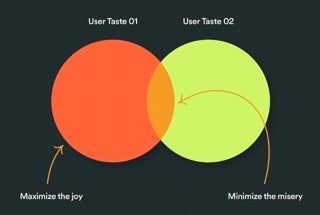
Photo via Spotify Engineering
With the knowledge of this choice, a lot of things about Blend began to make more sense to me as a user – especially the Blend I made on a recent first date. After just an hour of knowing each other, he asked the timeless question, “Should we make a Blend?” In a second our phones were out, sharing the invitation, and comparing tastes to see how well Spotify knew us. Turns out, not very well.
Despite giving us a taste match of 97%, a few minutes of investigating the playlist proved otherwise. He immediately called it a ‘bad blend’ because of how many songs were allegedly incorrectly attributed to his music taste. His tastes aligned more with hip hop and R&B, but Spotify was branding him as a pop connoisseur, which he fervidly denied. My selections were also not as tailored as the feature implied. I was happy with most of my songs, but I would catch the occasional stray that, similarly, had me rush to defend my honor.
In my experience with Blends, they are more fun when you have music in common with your companion, something Lamere can attest to, “It’s a bit simpler to create a Blend with users with similar taste since they listen to a lot of the same music. However, if we have two users with no common music listening history, it’s significantly more difficult to create a perfect Blend.”
Maybe we were doomed from the beginning, but some digging into his profile proved we didn’t have to be. Outside of the Blend, we had a good amount of artists and songs in common that were nowhere to be found on our shared playlist. One playlist of his, marked only with a red heart, was full of old soul love songs that I also knew and cherished. None were on the Blend, though, which tells me it has since fallen out of his listening rotation.
Despite the crushing realization that our music compatibility was nowhere near 97% in reality, I still learned two very valuable lessons: Do not depend on Spotify to help you learn about another person, and do not introduce your favorite album to a man who may or may not use it on another date.