
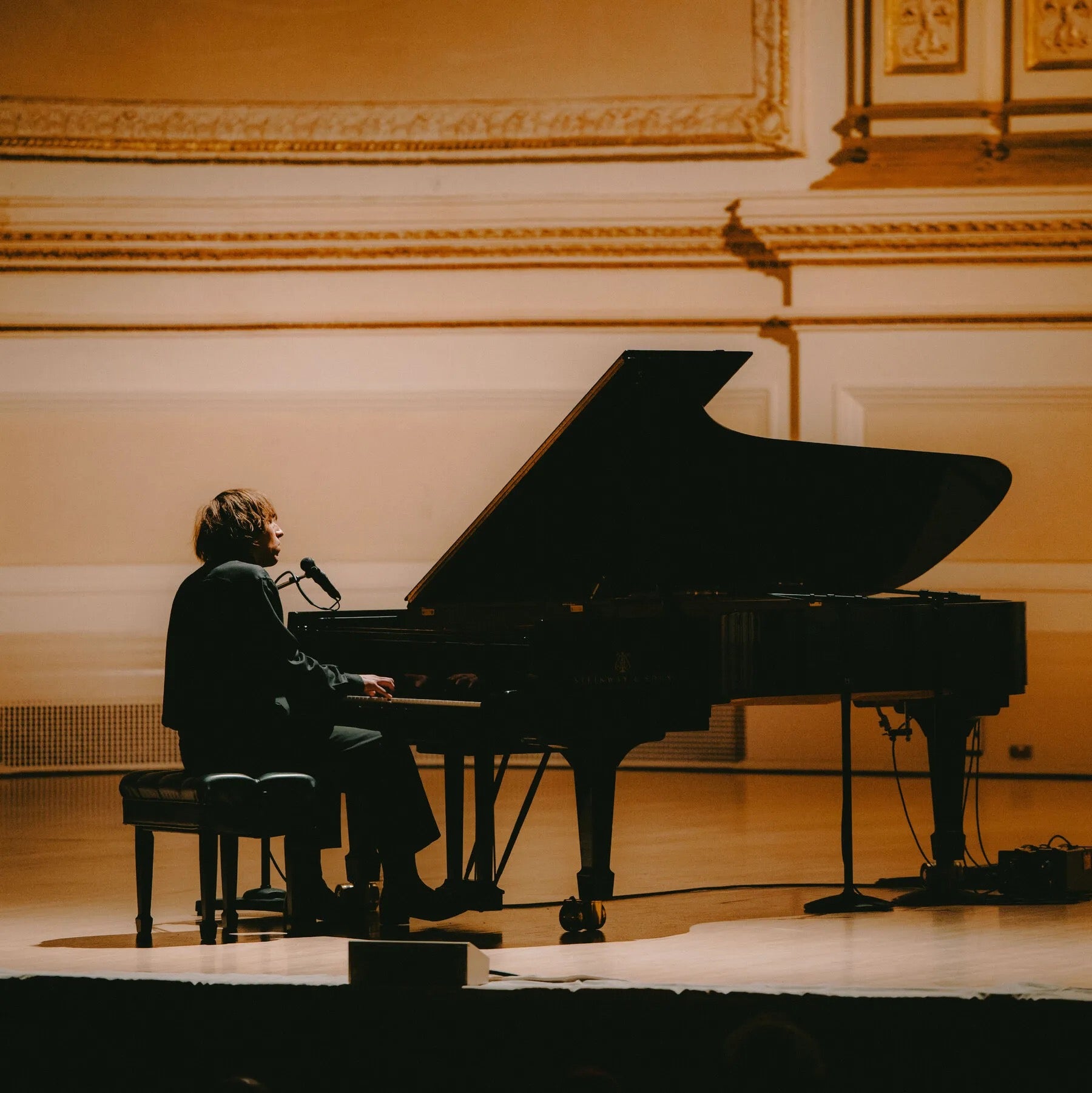
Image courtesy of The New York Times
There is something delightfully absurd about Cameron Winter playing Carnegie Hall. The frontman of Geese; Brooklyn's wonderfully strange answer to the question of where rock music goes next, trading the chaos of indie-rock stardom for one of the most storied stages in American music. And yet, watching him sit alone at the piano makes perfect sense.
Live at Carnegie Hall feels like a small but significant statement about the direction music is headed in. Not necessarily toward a new genre, sound, or even really a movement, but toward something much harder to manufacture: a distinct artistic identity; one we haven't had in quite some time.
We spent decades, centuries, inventing new musical languages. The 90s and 2000s especially, gave us an extraordinary proliferation of genres and subgenres, each one with their own vocabulary and aesthetic. Today, particularly as Music Director for KWVA, I've noticed that the boundaries between these genres feels increasingly porous. Pop borrows from R&B, country borrows from hip-hop, indie borrows from practically everything, and the most interesting artists are usually the ones who refuse to stay in their assigned lanes; the people who can do it all.
This presents a tricky challenge for emerging artists. How do you make something genuinely new and inventive when so much of what you hear has already been made? And even more so, how do you make it sound good when the technology available to you has made technical polish and perfect production almost an expectation? We demand perfection from our artists these days because we assume they have the tools to do so. Everything is accessible so it seems that there is no excuse to produce anything less than a masterpiece, right?
But I believe that the ability to make a record sound immaculate is not the same as having something interesting to say.
Perhaps this is why we keep returning to the past. Consider Jalen Ngonda's new album, for example. His 2026 work, Doctrine of Love, sounds like it arrived by way of a time machine from the golden age of 70s soul. Don't get me wrong, Ngonda's craftsmanship is undeniable, and the appeal of his rediscovered sounds is hardly difficult to understand. But there is a difference between reviving an old sound and making that sound feel alive again. To quote my poetry professor: "Nostalgia can be a destination, or it can be starting point."
Winter understands this distinction, masterfully so. On his Carnegie Hall album, we hear his songs shed much of their original instrumentation to reveal the older American traditions that are pulsing beneath them. Gospel, blues, Appalachian folk, and the deliciously grand (occasionally melodramatic) tradition of the American piano ballad all seem to have a place in his tracks. The arrangements are sparse enough to expose his songwriting, but the songs themselves refuse to be stagnate. They stretch, swell, stumble, and even occasionally stand on the verge of coming apart entirely. Each song has a loping, rolling style to it that keeps you on your toes in an almost enchanting way. What Winter is doing here is connecting ferocity to his emerging instinct. The album is a perfect example of a phrase recently introduced to me (also from my poetry professor) called Dionysian consciousness, which describes a form of thinking characterized by chaos and emotion. It focuses on intuition, passion, ecstasy, and unity. It was the type of consciousness Marvin Gaye used when he composed his jazz improvisations over the course of hours. Now, we get the pleasure of listening to Winter use it firsthand. He is letting go of structure and Apollonian consciousness to let the music carry him. It's INCREDIBLE.
His voice helps as well. It is strange and unmistakably his own, wounded and mischievous all at once. There is a kinship here with Leonard Cohen, particularly in the ability to place the sacred beside the ridiculous without diminishing either.
The performance of "$0" captures this perfectly. As the song builds towards its conclusion, Winter starts to circle the reality of God with an intensity that sits right between revelation and a very hilarious personal crisis. The piano grows louder and the condition becomes almost theatrical and campy. The moment manages to be manic, funny, sad, and transcendent all at once.
As someone working in music publishing, programming, and scouting at the collegiate level, I spend a lot of time thinking about what makes an artist worth paying attention to. There is always another technically impressive vocalist, another beautifully produced track, or another artist that knows how to assemble an album into something marketable. But the artists that stay with me are the ones who make me curious about what they will do next. They have a perspective, a certain sensibility, but they also don't take themselves too seriously.
Winter has that quality. He is already finding an audience among young listeners, but I suspect his appeal will extend well beyond the indie-rock ecosystem that first introduced him to so many of us. The venue itself is a suggestion that the future of music does not always require us to abandon the past. Winter has carved out a wonderful little corner of the present and placed it in conversation with something much older.
I do not think the next great musical movement will necessarily arrive with a new genre name or a completely unprecedented sound. We may be entering an era in which originality has less to do with inventing new ingredients and more to do with combining familiar ones in ways that feel deeply personal.
I enjoy that Cameron Winter does not seem particularly interested in proving that he knows his influences. Rather, he seems interested in finding out how far he can take them.
All in all, I know we are in good hands and I look forward to seeing what the future holds for music.