
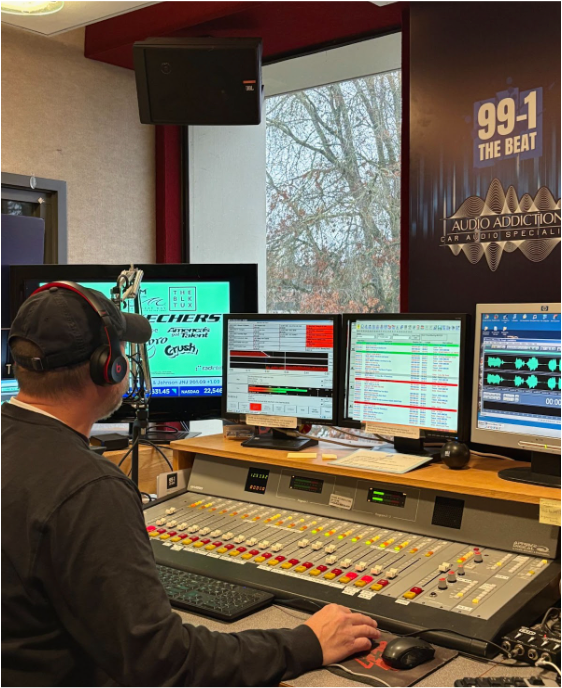
Barry MacGuire at 99.1 The Beat in Eugene, Oregon. Photo by Noah Samuelsen
The name Barry MacGuire has the kind of alliterative, punchy ring that feels pulled from a 1960s superhero comic – simple, strong, memorable, and sounding every bit like the protagonist in a classic caped adventure. Although you probably won’t catch Barry MacGuire soaring through the sky or zapping lasers from his eyes, he’s still very much a hero, just one who is the sound of the radio at 99.1 The Beat Eugene.
When MacGuire first gave me the station’s address, I geared up to arrive at a squat, retro radio house perched atop a hill, framed by a monstrous radio tower. You know, the kind that evokes that old-school, slightly kitschy vibe, with big black letters spelling out the station’s call sign above the door. But when I pulled into the lot, I was met instead with a three-story, all-white commercial building with shiny windows. The only hint that it was a radio station was the cluster of antennas on the roof. That’s when I realized that many of us, myself included, don’t know much about how commercial radio operates today. And, the person who was about to show me how audio meets the ear was already waiting for me.
Barry MacGuire swung open the door to the station’s top-floor suite, greeting me with an ear-to-ear smile, a cheerful “Hey, welcome in!”, and a firm handshake. His bubbly radio personality was instantly infectious, and I didn’t need a drop of caffeine before he had me brimming to see what was around the corner. Following MacGuire through the main entrance, the office looked just like any other: a reception desk, filing cabinets, a long hallway dotted with doors, carpet underfoot, and the bright glow of fluorescent ceiling panels overhead. The space wasn’t just home to The Beat, either. The building houses four Eugene stations owned by Bi-Coastal Media, a small West Coast broadcasting company that operates dozens of stations across California, Oregon, and Washington. But once he led me into the on-air studio, it became clear that this office was more unique than I’d expected.
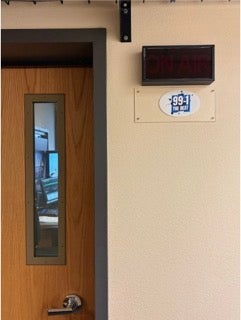
Photo by Noah Samuelsen
I felt like I’d stepped into a miniature NASA Mission Control, shrunk down and packed into a single room, the beating heart of 99.1 The Beat. Below their distinct blocky logo lay an array of buttons, dials, audio interfaces, mics, and computers. In each corner, a speaker the size of a toddler was suspended, looming over the room. The space was small, probably not much larger than a master bathroom, but MacGuire and The Beat made the most of it. To the untrained eye, it looked chaotic, yet it was the cleanest and most organized workspace I had ever seen. MacGuire immediately jumped into action.
The technical side of MacGuire’s job reveals just how much precision goes into making a radio show sound effortless. His computer screen was lined with rows of color-coded audio carts, digital snippets that hold a single piece of audio – from songs to jingles to weather updates. MacGuire bounced between software windows with practiced ease, sliding clips into exact time slots and choosing the music bed beneath his voice. The movements were quick and instinctive, the kind of muscle memory that comes from decades behind a microphone.
All of that technical choreography is part of MacGuire’s daily routine. He kicks off his show, “MacGuire in the Morning,” at 6 a.m. and wraps up at 10 a.m., switching to a pre-record around nine so the next DJ, Mandy in the Middays, can settle in. By the time I arrived, MacGuire was already deep into that process: laying down sound bites, talk breaks, and contest teases, and dropping each piece into its designated place before it airs. MacGuire turns to the mic.
“All right, the moment you’ve been waiting for… two hours of commercial-free throwbacks for your workday. Ice Cube on the way. Notorious B.I.G., The Game, and 50 Cent up next – 99.1 The Beat.”
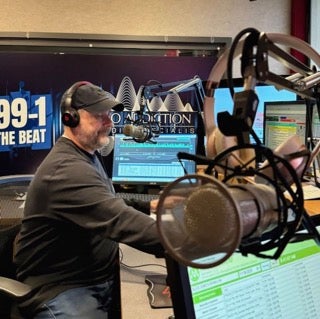
Photo by Noah Samuelsen
Like many long-running stations, 99.1 The Beat has reinvented itself more than once. It first launched as Oldies 99.1 in the early 1990s, spinning hits from the 1950s and ’60s before rebranding as Cool 99.1, a station built around classic rock and feel-good throwbacks. Even as the music shifted, the call letters KODZ stayed the same, mainly because changing them required a maze of paperwork. In 2023, the station made its most significant pivot yet, flipping to The Beat and embracing a throwback R&B and hip-hop format that now defines its sound across Eugene.
Barry MacGuire has witnessed much of that evolution firsthand. He’s been with 99.1 since 2001, but his path to Eugene was anything but linear. He grew up in Vancouver, Canada, initially setting his sights on becoming a sports broadcaster, and even attended the Columbia School of Broadcasting in Los Angeles. After graduating, he volunteered at a small station in Bellingham, Washington, running the control board for high school football games before securing his first Top 40 night shift. That kicked off a string of moves through San Jose, Redding, and Cheyenne, each stop shaped by low pay, format flips, or stations running into financial trouble. When KDUK, another Eugene station owned by Bi-Coastal Media, hired him in the late ’90s, he expected a steady night shift. But just two weeks in, the morning host left, and MacGuire was offered the slot. He spent eleven years hosting KDUK’s The Breakfast Club before shifting over to 99.1 as Program Director, eventually taking on roles in music scheduling and commercial production. He’s been shaping the station’s sound ever since, through Oldies, Cool, and now The Beat.
Today, Barry MacGuire’s role is far from limited to being a radio DJ. He wears many hats. Across the radio industry, downsizing has become the norm as stations try to cut rising costs, and MacGuire is a prime example of that shift. In addition to hosting his morning show, he serves as Program Director, schedules the music as Music Director, produces and edits commercials as Production Director, and helps keep the station sounding local and lively. Perhaps most surprisingly, commercials are his favorite part of the job. They give him room to be creative without the constant pressure of being “on,” he says, and offer a rare chance to focus on crafting something instead of performing it.
Not everything in radio goes smoothly, though. MacGuire laughed as he recalled a contest winner years ago who picked up the phone, screamed an excited F-bomb live on air, and hung up. There was no delay system at the time, no way to censor it. “All you can do is apologize to the listeners and move on,” MacGuire said. “That’s live radio for you.”
Indeed, that is live radio. So is watching MacGuire glide through a screen full of carts without hesitation and feeling the energy in the room shift the moment he leans into the mic. Barry MacGuire may not wear a cape or leap off rooftops, but what he does requires its own kind of superpower. It takes instinct, personality, curiosity, and a whole lot of hustle to keep a station alive in 2025. Behind the airwaves of 99.1 The Beat is a command center staffed by only a few individuals, including MacGuire, who juggle music, timing, news, weather, contests, commercials, and everything in between, somehow making it sound effortless. In a media world that often feels automated and distant, MacGuire stands out as something rare: a real human voice holding it all together.

Photo by Noah Samuelsen